Packaging cost for baked goods: cost per box and order
Turn case prices into packaging cost per item and order, then include that cost inside the marked-up cost base.
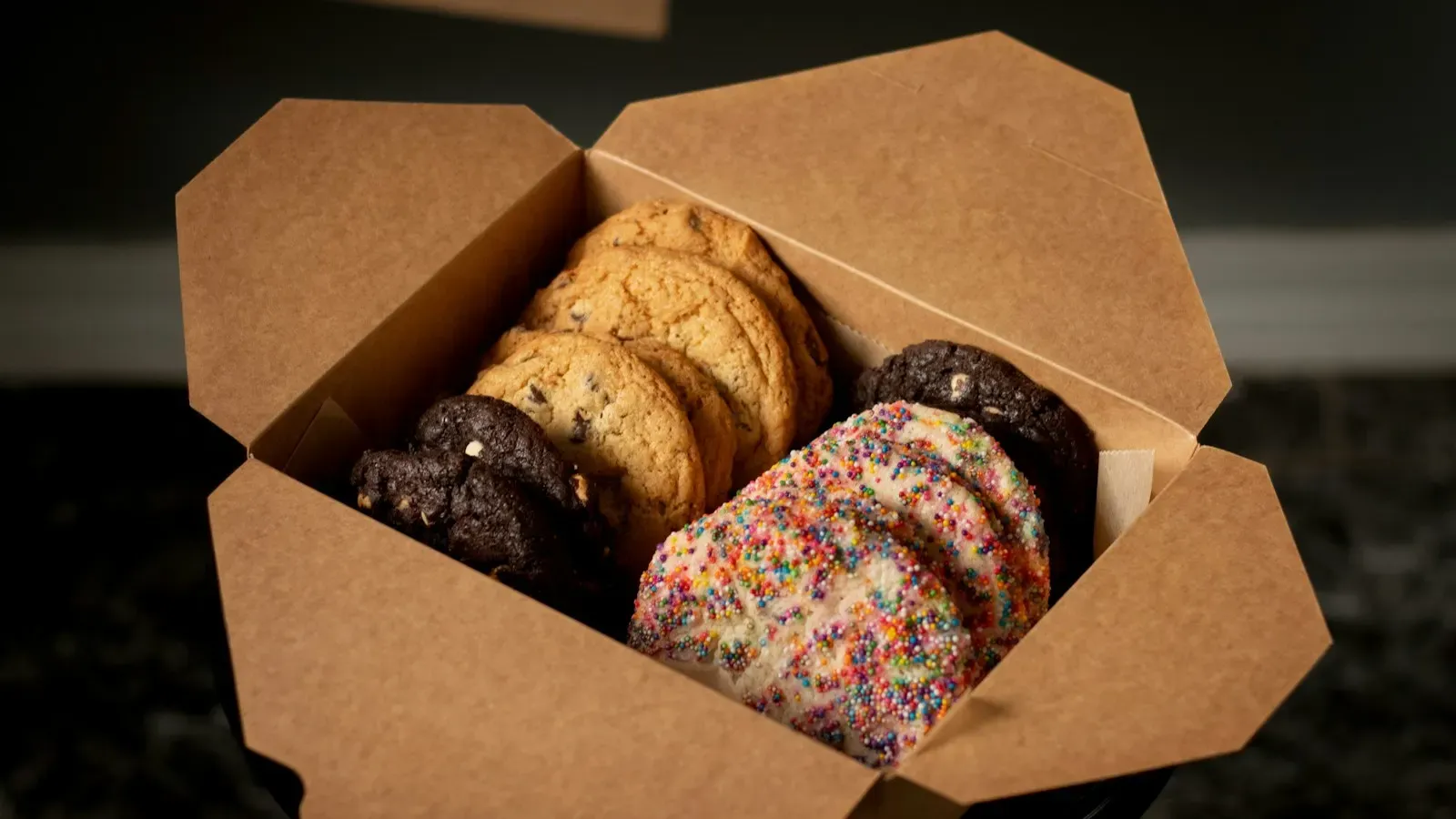
Packaging cost in a bakery is the case price divided by usable packaging yield, assigned to the order that consumes it. In the worked 12-item batch below, $3.20 of packaging sits inside the cost base. At a 35% margin, that packaging is marked up with ingredients and labor instead of passing through at cost.
A box looks like an accessory until you have 400 of them stacked in a hallway and several hundred dollars missing from the bank account.
Packaging is inventory with excellent branding and terrible timing.
That cake box isn’t free: the math starts with the case
Three examples show why “about fifty cents” is not a system.
| Packaging item | Pack or case | Example price | Unit cost |
|---|---|---|---|
| 8 x 8 x 5 bakery box | 100 | $53 | $0.53 |
| 12-cupcake high-dome container | 100 | $107 | $1.07 |
| Clear bread bag | 1,000 | $30 | $0.03 |
Shipping, membership, quantity tiers and location can move the landed cost. Use the amount you actually pay.
The formula is plain:
purchase price / usable quantity = packaging unit cost
If 10 boxes arrive crushed in a 100-case, your usable yield is 90, not 100.
That is the packaging version of a recipe that claims 24 cookies and gives you 21.
Cost of bakery packaging by order
A product can consume more than one packaging item.
Suppose a 12-item order uses:
- one main box
- 12 liners
- one sheet of parchment
- one label
- one outer bag
Cost each part, then add them.
If the total is $3.20, that $3.20 belongs to the order.
Do not bury it inside ingredients. Do not call it overhead if it leaves with one customer. Packaging is usually a variable product cost.
The fixed vs variable bakery costs guide explains that classification in detail.
Why $3.20 changes the selling price
Use this batch:
| Item | Batch amount |
|---|---|
| Ingredients | $12.00 |
| Packaging | $3.20 |
| Labor | $18.00 |
| Extras | $1.50 |
| Full batch cost | $34.70 |
| Yield | 12 |
| Unit cost | $2.89 |
| Price at 35% margin | $4.45 |
Exact unit cost:
($12 + $3.20 + $18 + $1.50) / 12 = $2.891667
Exact model price:
$2.891667 / 0.65 = $4.448718
If you remove packaging from the marked-up cost base and simply add $3.20 after pricing the rest, you are using a different formula from the site’s calculator.
Receitório’s formula marks packaging up because packaging is part of what the sale consumes.
The box does not get a diplomatic exemption from margin.
Packaging can be small per piece and large per order
A $0.53 box spread across 12 cookies is about 4.4 cents per cookie.
A $1.07 cupcake clamshell spread across 12 cupcakes is about 8.9 cents each.
Nine cents sounds like a rounding error.
Now sell 100 dozen cupcakes. You used roughly $107 of clamshells before labels, liners and bags.
Small unit costs become real cash because bakeries sell repeated units.
That is why the cookie cost calculator and cupcake cost calculator keep packaging inside their batch tables.
Package yield is not always the printed count
Some packaging is damaged.
Some gets used for samples.
Some boxes fit the product technically and fail it operationally because frosting touches the lid or cookies slide around.
Your cost model should use the packaging you can actually send to customers.
If a case of 100 costs $60 and only 95 are usable:
$60 / 95 = $0.6316 per usable box
Using $0.60 because the invoice says 100 pieces understates packaging by about 5%.
Again, the spreadsheet did nothing wrong. It used the yield you gave it.
Custom packaging needs its own order logic
A wedding order may use a standard box plus individual favor bags, ribbon and custom stickers.
A holiday box may include inserts and a printed sleeve.
A corporate order may require branded labels you buy in a minimum quantity larger than the order.
Separate reusable stock from order-specific custom material.
If 500 custom labels cost $75 and the customer order uses 80, you have two defensible treatments depending on whether the remaining labels can be reused:
- reusable stock: cost 80 labels to this order and retain the rest as inventory
- order-specific design: assign the full custom purchase if the remainder has no future value
The correct choice depends on what happens to the leftovers, not which answer makes the quote prettier.
Packaging cost is not payment fee
Both can be small percentages of a sale, but they behave differently.
Packaging is a physical cost that usually scales with units or orders and belongs in the cost base.
Card processing is a transaction cost that can combine a percentage with fixed cents.
The payment processing fees guide works through that math.
Keeping them separate lets you see whether an expensive presentation or an expensive channel is doing the damage.
Record shelf packs naturally, cost recipes consistently
A US supplier may sell 100 boxes per case and flour by the 5 lb bag.
That is fine.
For ingredients, convert the pack weight to grams because the app is metric and count only. For packaging, use “Unit” or “Box” where appropriate.
The app does not accept pounds, even when the flour bag says pounds.
Buy the pretty box after the math
Premium packaging can absolutely support a premium product.
The cost sheet is not telling you to ship a wedding cake in a grocery sack.
It is telling you that a $4 presentation choice should appear as $4 before you decide what the presentation is worth to the customer.
Put your actual packaging into the bakery pricing calculator, then decide whether the box is earning its shelf space.
Shipping and freight belong in landed packaging cost
A supplier may list a case at $53 and charge $18 to deliver it.
If that order contains only the 100 boxes, landed case cost is $71.
$71 / 100 = $0.71 per box
The catalog unit cost was about $0.53.
The landed unit cost is about $0.71.
That difference is 18 cents per order before labels or inserts.
If freight is shared across several supplies, allocate it consistently. Weight, purchase value or item count can all be workable methods depending on the order.
Do not ignore freight just because the website prints it on a different line.
Branded packaging can create dead inventory
Custom stickers and printed boxes usually get cheaper at larger quantities.
That discount can be expensive if the design becomes unusable.
Suppose 1,000 branded labels cost $120, or 12 cents each.
You use 300 before changing the logo.
The 700 leftovers represent $84 of inventory that no longer has a customer-facing use.
That loss belongs somewhere in the business.
A small bakery should compare the unit saving from a large print run with the risk that demand, branding or product dimensions change first.
The cheapest unit is not always the cheapest purchase.
Packaging should match the product standard
If a cookie box holds twelve only when cookies are 2.5 inches wide, a larger cookie can cut packaging yield before ingredient yield changes.
You may suddenly need a bigger box.
That is why product dimensions belong next to packaging decisions.
Test the finished product in the exact container before you set a permanent cost.
A box that technically closes while frosting touches the lid is not a usable box.
Packaging yield is the number of customer-ready orders the purchase actually supports.
Stop pricing by guesswork.
Add recipes, ingredients and packaging for free. When you want the price calculated for real, with inventory and sales, unlock Operations on the site or with a one-time purchase.



Still wondering?
01 How do I calculate packaging cost per item?
Divide the case price by the number of usable boxes. In the example here, that is about $0.53 per bakery box.
02 Should packaging be included in bakery pricing?
Yes. In the worked 12-item batch, $3.20 of packaging sits inside the cost and is marked up with the rest of the cost base.
03 How much does a cupcake container cost?
About $1.07 each for a 12-compartment high-dome container bought by the case of 100, before shipping or quantity changes.
04 Do labels and liners count as packaging cost?
Yes. If a liner, sticker, insert or bag leaves with the order, assign its actual per-order cost.
05 Is packaging a fixed or variable bakery cost?
Usually variable. The $3.20 in this example rises and falls with the batch. Bulk storage equipment is different, but boxes and bags normally rise with orders.